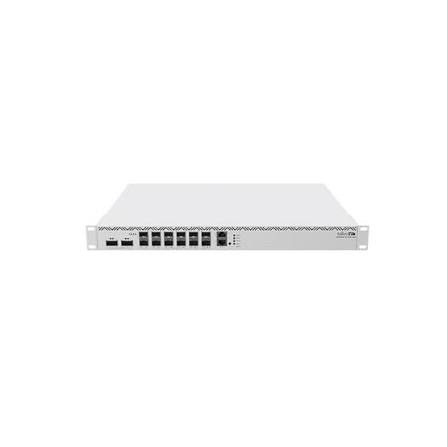
MikroTik CCR2216-1G-12XS-2XQ
Buy MikroTik CCR2216-1G-12XS-2XQ in Kenya from Orbitlink Solutions. 12×25G SFP28, 2×100G QSFP28, 16-core ARM64 CPU, 16GB RAM and L3 Hardware Offloading.
MikroTik CCR2216-1G-12XS-2XQ Cloud Core Router in Kenya
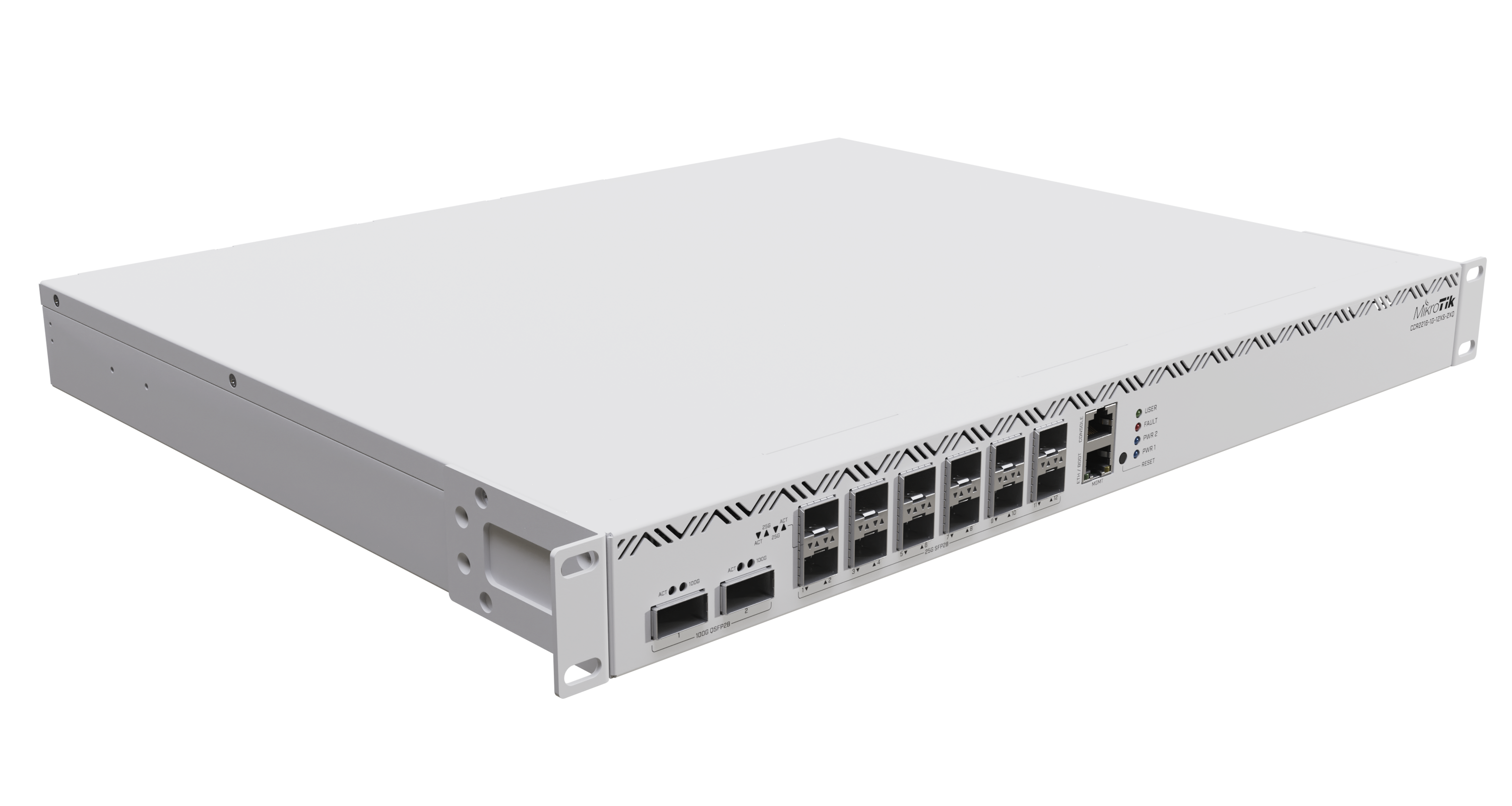
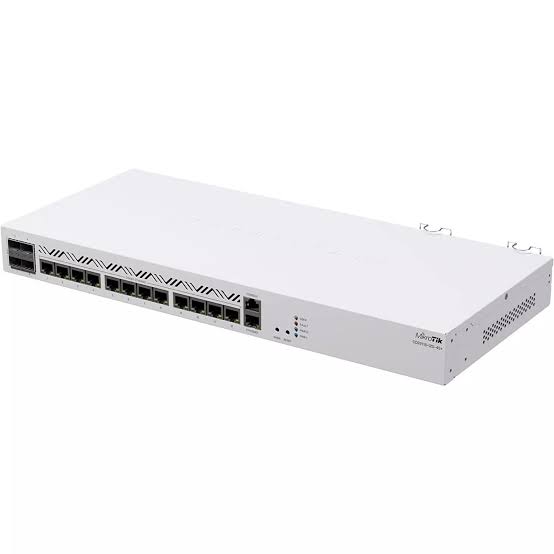
The MikroTik CCR2216-1G-12XS-2XQ is a flagship Cloud Core Router designed for 100 Gigabit ISP, carrier, data-centre and high-capacity enterprise networks. Its interface configuration includes 12 × 25G SFP28 ports, 2 × 100G QSFP28 ports and one Gigabit Ethernet management port, allowing it to sit at the core or edge of networks that have moved far beyond conventional 1G and 10G routing.
At its core is the AL73400 16-core 2GHz ARM64 processor, backed by 16GB DDR4 RAM and the Marvell Prestera 98DX8525 switch chip. The platform supports Layer 3 Hardware Offloading, allowing supported routing operations to be handled in switch hardware rather than forcing every packet through the CPU.
MikroTik positions the CCR2216 as a natural upgrade path for older CCR1072 installations. It also adds dual M.2 SATA storage slots, redundant hot-swappable power supplies and replaceable cooling fans, making it particularly suitable for critical rack infrastructure.
MikroTik CCR2216-1G-12XS-2XQ Key Features
| Feature | Specification |
|---|---|
| Model | CCR2216-1G-12XS-2XQ |
| Product Family | Cloud Core Router |
| Architecture | ARM 64-bit |
| CPU | AL73400 |
| CPU Cores | 16 |
| CPU Frequency | 2GHz |
| RAM | 16GB DDR4 |
| Storage | 128MB NAND |
| Gigabit Ethernet | 1 × 1G |
| 25G SFP28 | 12 ports |
| 100G QSFP28 | 2 ports |
| M.2 Slots | 2 × SATA |
| Switch Chip | Marvell 98DX8525 |
| Switch-to-CPU Connection | 4 × 25Gbps |
| RouterOS | RouterOS v7 |
| RouterOS Licence | Level 6 |
| Power Supplies | Dual redundant |
| Maximum Power Consumption | 128W |
| Dimensions | 443 × 367 × 44mm |
| Operating Temperature | -20°C to +60°C |
| Ingress Protection | IP20 |
| Best For | ISP core, BGP, carrier, data centre, 25G/100G routing |
12 × 25 Gigabit SFP28 Ports
One of the defining features of the CCR2216 is its twelve SFP28 cages capable of 25Gbps operation. Each SFP28 interface also supports selected lower link rates, giving network designers flexibility when migrating existing infrastructure toward 25G.
MikroTik currently documents these supported SFP28 speeds:
| SFP28 Mode | Support |
|---|---|
| 25Gbps | Yes |
| 10Gbps | Yes |
| 5Gbps | No |
| 2.5Gbps | Yes |
| 1Gbps | Yes |
This means an ISP can begin with existing 10G optics on selected interfaces and migrate links toward 25G as network capacity grows, provided the modules and link partners are compatible.
Dual 100G QSFP28 Interfaces
The CCR2216 also provides two QSFP28 interfaces capable of 100 Gigabit Ethernet.
These ports make the router suitable for high-capacity connections between:
-
Internet transit providers
-
Core switches
-
Data-centre switches
-
ISP aggregation layers
-
Internet exchange infrastructure
-
High-capacity routers
-
Network POPs
-
Server infrastructure
A typical architecture might be:
25G Access/Aggregation Links
↓
CCR2216-1G-12XS-2XQ
↓
100G QSFP28
↓
Core Switch / Upstream Provider
QSFP28 Breakout Support
The 100G interfaces provide considerably more flexibility than simply operating at 100Gbps.
MikroTik currently documents support for:
| QSFP28 Configuration | Supported |
|---|---|
| 1 × 100G | Yes |
| 2 × 50G | Yes |
| 1 × 50G | Yes |
| 1 × 40G | Yes |
| 4 × 25G | Yes |
| 4 × 10G | Yes |
| 4 × 1G | Yes |
| 2 × 40G | No |
With compatible breakout hardware, this gives network engineers considerable flexibility when connecting equipment operating at different interface speeds.
16-Core 2GHz ARM64 Processor
The CCR2216 uses the Annapurna Labs AL73400, a 16-core ARM64 processor running at 2GHz.
| CPU Specification | Value |
|---|---|
| CPU | AL73400 |
| Architecture | ARM64 |
| Cores | 16 |
| Clock Speed | 2GHz |
This is the same general CPU family used by the CCR2116, but the CCR2216 surrounds it with substantially faster network interfaces and a higher-capacity switching architecture.
MikroTik designed the platform for demanding operations including BGP, high packet-rate routing, firewalling, VPN, QoS and high-capacity network aggregation.
16GB DDR4 RAM
The CCR2216 includes 16GB DDR4 RAM and 128MB NAND storage.
The large memory capacity makes the router particularly useful for professional networks dealing with:
-
Large routing tables
-
BGP
-
Multiple BGP peers
-
Large connection tables
-
Extensive firewall policies
-
VPN
-
Dynamic routing
-
Large VLAN environments
-
ISP core networks
-
Complex RouterOS configurations
For an ordinary small-office gateway, this level of hardware would generally be unnecessary.
Marvell Prestera 98DX8525 Switch Chip
The CCR2216 incorporates a Marvell Prestera 98DX8525 switch chip.
The switch chip is a major part of the platform because it enables high-speed switching and supported hardware-offloaded Layer 3 operations.
The switch-to-CPU connection is specified as:
4 × 25Gbps
providing an aggregate 100Gbps connection between the switching subsystem and CPU.
This architecture is important when interpreting the router's many 25G and 100G interfaces: port capacity and CPU-routed throughput are not the same thing. Hardware offloading and the actual RouterOS configuration determine how traffic is processed.
Layer 3 Hardware Offloading
MikroTik highlights L3 Hardware Offloading as one of the CCR2216's most important capabilities.
Instead of processing every supported routed packet through the main ARM CPU, suitable Layer 3 traffic can be handled directly by the Marvell switch hardware.
This can be particularly valuable for:
Inter-VLAN routing
ISP aggregation
Data-centre routing
High-throughput internal networks
Large routed campus networks
Core infrastructure
Hardware offloading is configuration-dependent. Not every RouterOS feature or traffic flow can necessarily be processed entirely in hardware.
RouterOS v7
The CCR2216 is a RouterOS v7-only platform with a Level 6 licence.
RouterOS provides functionality including:
-
BGP
-
OSPF
-
IPv6
-
VLANs
-
Layer 3 Hardware Offloading
-
Firewall
-
NAT
-
VPN
-
QoS
-
Queues
-
Policy routing
-
DHCP
-
PPPoE
-
Multi-WAN
-
Monitoring
-
SNMP
-
Scripting
MikroTik recommends upgrading the device to the latest applicable RouterOS version to receive current stability and security updates.
MikroTik CCR2216 for BGP
The CCR2216 is particularly relevant to networks using Border Gateway Protocol.
Potential environments include:
Internet Service Providers
Autonomous System operators
Internet exchanges
Data centres
Large enterprise networks
Carrier networks
A possible design is:
Transit Provider A — 100G
↓
CCR2216
↑
Transit Provider B — 100G
↓
25G Aggregation / Core Infrastructure
Its 16GB RAM and 16-core processor provide significant resources for large routing environments, while RouterOS v7 provides MikroTik's current BGP implementation.
MikroTik CCR2216 for Internet Service Providers

The CCR2216 is primarily a professional ISP and carrier-class platform rather than a conventional business internet router.
Potential applications include:
-
ISP core routing
-
BGP edge routing
-
Internet transit
-
IXP connectivity
-
100G uplinks
-
25G aggregation
-
OSPF
-
High-capacity VLAN routing
-
CGNAT architectures
-
PPPoE infrastructure
-
Network interconnection
-
Firewalling
-
Traffic engineering
-
High-capacity VPN
A possible ISP topology is:
Internet Transit / IXP
↓
100G QSFP28
↓
CCR2216
↓
25G SFP28
↓
Distribution / POP / OLT / Wireless Backhaul
MikroTik CCR2216 for 100G Networks
The CCR2216 provides a relatively accessible route into 100 Gigabit RouterOS networking.
A 100G interface can be useful where many lower-speed network links converge at one location.
For example:
4 × 25G Distribution Links
↓
CCR2216
↓
100G Core
This does not mean every RouterOS configuration will route 100Gbps through the CPU. Network engineers need to consider hardware offloading, packet size, firewall processing, queues, NAT, VPN and other workloads when designing the system.
MikroTik CCR2216 for Data Centres
The CCR2216 can also serve as a high-capacity data-centre routing platform.
Possible applications include:
Internet edge routing
BGP
25G server or switch connectivity
100G core uplinks
Inter-VLAN routing
Network segmentation
Firewall gateway
VPN
Storage/network infrastructure
Its QSFP28 and SFP28 interfaces allow it to connect directly into modern high-speed switching environments without forcing every connection through 10G adapters.
MikroTik CCR2216 for Enterprise Networks
The CCR2216 can be used by large organisations operating substantial internal networks.
Examples include:
-
Universities
-
Large campuses
-
Financial institutions
-
Telecommunications companies
-
Large hosting environments
-
Multi-building enterprises
-
Research networks
-
Large government networks
For a normal office with a 1Gbps or even several-gigabit internet connection, the CCR2216 is usually excessive. Its strengths become relevant where 25G and 100G networking are genuine infrastructure requirements.
MikroTik CCR2216 for VLAN Routing
The router can serve as the Layer 3 core for a large VLAN environment.
For example:
| VLAN | Purpose |
|---|---|
| 10 | Core Management |
| 20 | Corporate Users |
| 30 | Guest |
| 40 | CCTV |
| 50 | VoIP |
| 60 | Servers |
| 70 | Storage |
| 80 | ISP Infrastructure |
| 90 | Data Centre |
| 100 | Transit |
Where supported by the configuration, Layer 3 Hardware Offloading can move suitable routing workloads to the switch chip rather than processing all traffic through the CPU.
MikroTik CCR2216 for OSPF
RouterOS v7 supports OSPF, allowing the CCR2216 to participate in large dynamically routed networks.
For example:
CCR2216 Core
↕
POP Router 1
↕
POP Router 2
↕
Regional Router
OSPF can automatically exchange internal network routes rather than requiring administrators to maintain every route manually.
This is particularly useful for ISP, campus and multi-site enterprise networks.
MikroTik CCR2216 for VPN
The CCR2216 can also perform VPN and encrypted-routing functions through RouterOS.
Possible applications include:
Data Centre ↔ Data Centre
ISP POP ↔ Core
Enterprise ↔ Cloud
Head Office ↔ Remote Sites
However, 100G physical interfaces do not imply 100Gbps encrypted VPN performance.
VPN throughput depends on encryption algorithm, protocol, packet size, tunnel count, firewall processing and other RouterOS workloads.
Dual M.2 SATA Slots
The CCR2216 contains two M.2 SATA slots. MikroTik recommends SATA3 M.2 2280 B+M-key SSDs and currently states no specific capacity limitation for compatible drives.
This is an important distinction from the CCR2116's NVMe-oriented expansion.
The CCR2216 slots are SATA, so customers should not automatically purchase an NVMe-only SSD.
Additional storage can be useful for supported RouterOS applications and network services requiring local disk capacity.
Hot-Swappable Redundant Power Supplies
A major enterprise feature of the CCR2216 is its redundant power architecture.
The router accepts power from two 100–240V AC supplies, and MikroTik's design uses hot-swappable PSU modules.
This allows infrastructure to be designed with:
PSU 1 → UPS A
PSU 2 → UPS B
If one power source or supply fails, the remaining path can help keep the router operating.
MikroTik also designed the CCR2216 as a convenient CCR1072 upgrade, including compatibility considerations for existing power-supply infrastructure.
Hot-Swappable Cooling Fans
The CCR2216 also uses four hot-swappable fans, an important feature for equipment expected to remain operational continuously.
If a cooling fan develops a fault, the replaceable design can simplify servicing compared with equipment requiring the entire router to be removed from production.
The front-panel FAULT LED can indicate cooling-fan problems.
Power Consumption
Official documentation specifies:
| Power Specification | Value |
|---|---|
| AC Inputs | 2 |
| AC Input Range | 100–240V |
| Maximum Without Attachments | 80W |
| Maximum Power Consumption | 128W |
Actual power usage can depend on installed optical modules, SSDs and workload.
For critical ISP installations, power calculations should include the router, transceivers, switches, cooling and sufficient UPS runtime.
1U Rackmount Design
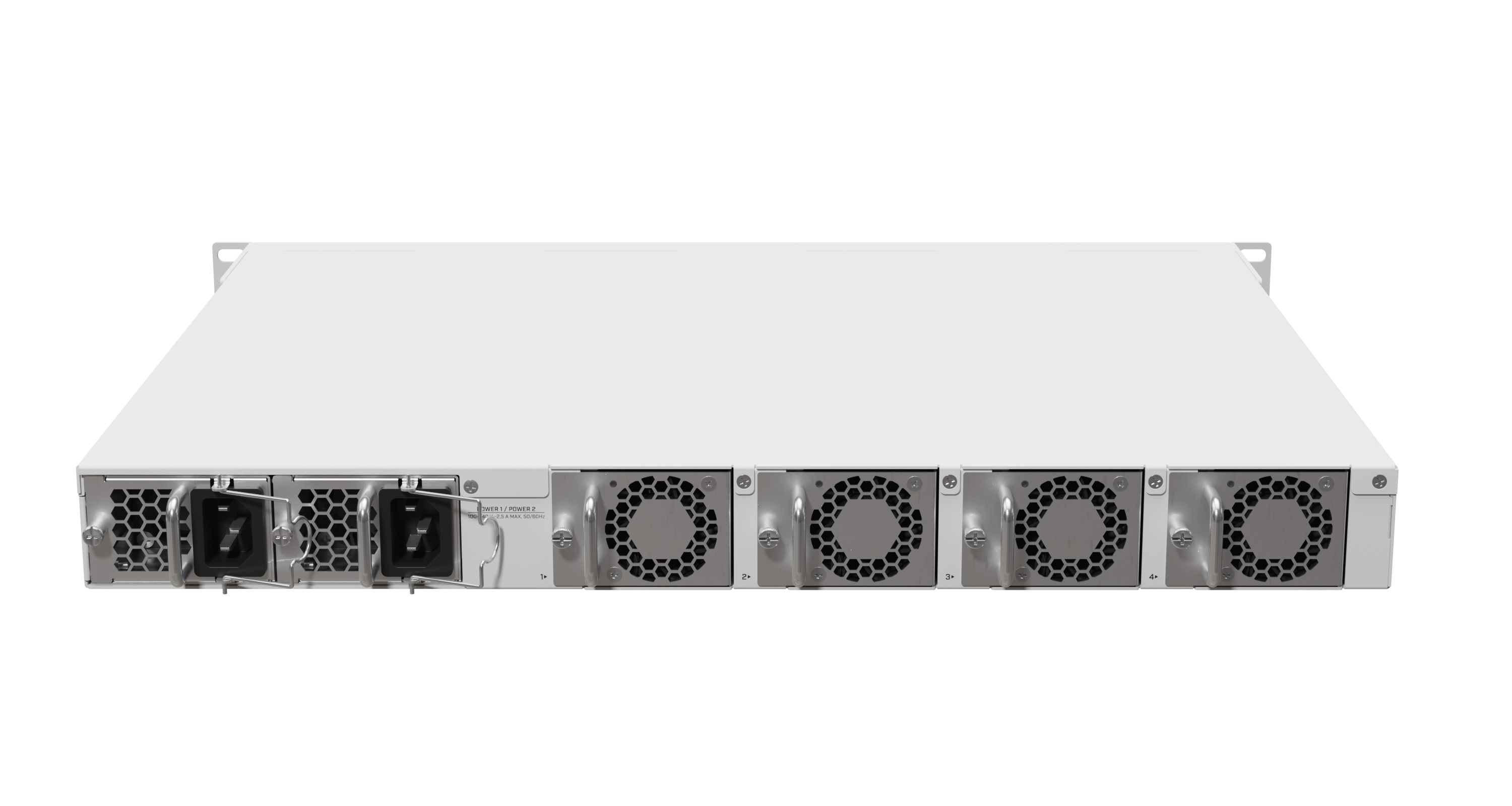
Despite its considerable routing capability, the CCR2216 fits into a 1U rackmount chassis measuring approximately 443 × 367 × 44mm.
The router is intended for indoor installation in a dry, ventilated environment and carries an IP20 ingress rating.
It is therefore most appropriate for:
-
Data centres
-
Server rooms
-
ISP POPs
-
Network operations centres
-
Telecommunications racks
rather than outdoor cabinets without appropriate environmental protection.
CCR2216 vs CCR2116
The CCR2116 and CCR2216 share the same general 16-core ARM64 CPU class, but their interface architecture is dramatically different.
| Feature | CCR2216-1G-12XS-2XQ | CCR2116-12G-4S+ |
|---|---|---|
| CPU | 16-core 2GHz ARM64 | 16-core 2GHz ARM64 |
| RAM | 16GB | 16GB |
| 1G Ethernet | 1 | 13 total |
| 10G SFP+ | Via compatible SFP28 operation | 4 native SFP+ |
| 25G SFP28 | 12 | None |
| 100G QSFP28 | 2 | None |
| M.2 | 2 × SATA | 1 × PCIe/NVMe |
| L3 HW Offload | Yes | Yes |
| Main Focus | 25G/100G core | 1G/10G high-performance routing |
| Best For | Carrier / ISP core / data centre | ISP / enterprise |
For an established 1G/10G network, the CCR2116 can be the more practical choice.
For an organisation building a 25G/100G core, the CCR2216 is in a different connectivity class.
CCR2216 vs CCR2004-1G-12S+2XS
| Feature | CCR2216 | CCR2004-1G-12S+2XS |
|---|---|---|
| CPU Cores | 16 | 4 |
| RAM | 16GB | 4GB |
| High-Speed Ports | 12 × 25G | 12 × 10G |
| Highest Native Port Speed | 100G | 25G |
| 100G Ports | 2 | None |
| 25G Ports | 12 | 2 |
| Main Role | Core / Carrier | Aggregation / ISP |
| Routing Class | Flagship | Mid-high tier |
The CCR2004 remains highly capable for 10G/25G aggregation.
The CCR2216 becomes appropriate when the network has genuinely progressed into 25G distribution and 100G core connectivity.
CCR2216 vs Older CCR1072
MikroTik specifically positions the CCR2216 as a drop-in upgrade path for existing CCR1072 deployments.
The older CCR1072 relied on MikroTik's many-core TILE architecture.
The CCR2216 moves to a modern ARM64 platform while adding:
25G SFP28
100G QSFP28
L3 Hardware Offloading
M.2 SATA storage
Modern RouterOS v7 architecture
MikroTik also highlights lower power consumption relative to its previous flagship.
SFP28 vs QSFP28
Understanding these interfaces is essential before purchasing the CCR2216.
| Interface | Typical Native Speed | CCR2216 Quantity |
|---|---|---|
| Gigabit Ethernet | 1Gbps | 1 |
| SFP28 | 25Gbps | 12 |
| QSFP28 | 100Gbps | 2 |
SFP28 typically carries one high-speed lane.
QSFP28 combines multiple high-speed lanes and can support 100G as well as compatible breakout configurations.
Choosing SFP28 and QSFP28 Modules
A CCR2216 deployment may require:
-
SFP modules
-
SFP+ modules
-
SFP28 modules
-
QSFP28 modules
-
DAC cables
-
Active optical cables
-
Breakout cables
-
Fibre patch cords
Selection should consider:
Interface speed
Fibre type
Distance
Wavelength
Connector
Link partner
Module compatibility
Power consumption
For 100G deployments especially, optical planning should be completed before ordering modules.
Advantages of MikroTik CCR2216-1G-12XS-2XQ

The CCR2216 provides a rare combination of 12 × 25G interfaces, dual 100G QSFP28, a 16-core ARM64 processor, 16GB RAM, Layer 3 Hardware Offloading, redundant hot-swappable power and dual M.2 SATA expansion.
Its strongest advantages are high-speed interface density, RouterOS flexibility and the ability to integrate into existing MikroTik networks while supporting much faster backbone infrastructure.
For ISPs progressing from 10G toward 25G and 100G, it provides a logical step without moving away from RouterOS.
Limitations to Consider
The CCR2216 is not intended to replace every MikroTik router. It has only one conventional Gigabit RJ45 interface, requires separate optics or DACs for most network connections, uses active cooling and is far beyond the requirements of most homes or ordinary SMEs.
The 4 × 25Gbps switch-to-CPU connection also means network architects must distinguish between interface capacity, hardware-offloaded traffic and CPU-processed routing. Twelve 25G ports plus two 100G ports should not be interpreted as a promise that arbitrary firewall, queue, NAT or VPN configurations can all simultaneously route at aggregate physical port capacity.
Its M.2 slots are SATA rather than NVMe, and its high-speed network interfaces require careful transceiver and cabling selection.
Who Should Buy the CCR2216?
The CCR2216 is particularly appropriate for ISPs, telecommunications providers, data centres, Internet exchanges, hosting providers, large campus networks and enterprises operating genuine 25G/100G infrastructure.
It is usually unnecessary for a small office, ordinary Starlink installation or conventional Gigabit business network. In those environments, an RB5009, CCR2004 or CCR2116 may offer a better balance of price, ports and processing capability.
Typical CCR2216 Network Architecture
A high-capacity ISP deployment could look like:
100G Internet Transit A
100G Internet Transit B / IXP
↓
CCR2216-1G-12XS-2XQ
↓
25G Distribution Links
↓
Regional POPs / OLTs / Aggregation Switches / Data Centre
↓
Access Networks / Customers
This is the type of network architecture where the CCR2216's interface design begins to make practical sense.
What Is Included in the Box?
MikroTik's current documentation lists two power cords, rackmount ears, rear rack supports, a cable-management bracket and fastening hardware among the supplied accessories.
SFP28/QSFP28 optical modules, DACs, breakout cables and M.2 SATA SSDs should be selected separately according to the network design.
MikroTik CCR2216-1G-12XS-2XQ Price in Kenya
The MikroTik CCR2216-1G-12XS-2XQ price in Kenya can vary considerably according to exchange rates, stock, freight, taxes and the accompanying optics required for the deployment.
Rather than treating the router alone as the complete project cost, a 25G/100G deployment should budget for appropriate SFP28/QSFP28 transceivers, DAC or breakout cables, fibre patching, rack infrastructure, redundant UPS power and professional configuration.
Contact Orbitlink Solutions for the current CCR2216-1G-12XS-2XQ price and stock availability.
Why Buy MikroTik CCR2216-1G-12XS-2XQ from Orbitlink Solutions?
Selecting a CCR2216 should begin with the network architecture rather than simply choosing MikroTik's flagship router. A network dominated by Gigabit and 10G connections may be better served by a CCR2116, while a 10G aggregation network might fit a CCR2004. The CCR2216 becomes particularly compelling when 25G and 100G connectivity are real requirements.
Orbitlink Solutions can also help match the router with the appropriate SFP28/QSFP28 modules, fibre infrastructure, switches and other components needed to build a complete high-capacity network.
Watch the MikroTik CCR2216-1G-12XS-2XQ Video
The CCR2216-1G-12XS-2XQ represents a significant transition from traditional 1G/10G MikroTik routing into modern 25G and 100G infrastructure. Twelve SFP28 interfaces allow extensive 25G aggregation, while the two QSFP28 cages provide native 100G connectivity and flexible breakout options.
Its design is also about more than interface speed. The combination of the 16-core ARM64 processor, Marvell Prestera switch silicon and Layer 3 Hardware Offloading allows network engineers to decide which traffic needs CPU processing and which supported flows can be handled more efficiently in hardware. This distinction becomes increasingly important as network speeds move from 10G toward 100G.
For ISPs and data centres, redundancy is another important part of the design. Dual hot-swappable power supplies and replaceable fans make the platform better suited to continuous production environments, while two M.2 SATA slots provide additional storage flexibility. The result is a router intended to sit at a serious network core rather than simply act as an internet gateway.
Frequently Asked Questions About MikroTik CCR2216-1G-12XS-2XQ
What is the MikroTik CCR2216-1G-12XS-2XQ?
It is MikroTik's high-end ARM64 Cloud Core Router for 25G and 100G networking, ISP cores, data centres and other high-capacity routing environments.
How many 25G ports does CCR2216 have?
It has 12 SFP28 interfaces capable of 25Gbps.
How many 100G ports does it have?
It provides two QSFP28 interfaces capable of 100Gbps.
Can the 25G ports operate at 10G?
Yes. MikroTik documents support for 25G, 10G, 2.5G and 1G on the SFP28 interfaces. 5G is not supported.
Can the 100G ports be broken out?
Yes. MikroTik documents several supported configurations, including 4×25G and 4×10G, when used with appropriate compatible breakout hardware.
What CPU does CCR2216 use?
It uses the AL73400 16-core ARM64 CPU running at 2GHz.
How much RAM does CCR2216 have?
It has 16GB DDR4 RAM.
Does CCR2216 support Layer 3 Hardware Offloading?
Yes. L3 Hardware Offloading is one of the platform's headline capabilities.
What switch chip does it use?
It uses the Marvell Prestera 98DX8525.
What is the switch-to-CPU bandwidth?
MikroTik specifies 4 × 25Gbps connections between the switch and CPU.
Does CCR2216 support BGP?
Yes. RouterOS v7 provides BGP, making the CCR2216 suitable for ISP edge and core-routing environments.
Does it support OSPF?
Yes. RouterOS v7 supports OSPF.
Does CCR2216 support VLAN routing?
Yes, and supported configurations can benefit from Layer 3 Hardware Offloading.
Does it support VPN?
Yes, although encrypted throughput depends on protocol, encryption, packet sizes and configuration.
Does CCR2216 have Wi-Fi?
No. It is a wired high-capacity Cloud Core Router.
Does CCR2216 have normal Ethernet?
Yes, but only one 1G Ethernet interface, commonly used for management.
Does it have M.2 slots?
Yes. It has two M.2 SATA slots.
Can I install NVMe SSDs?
The official manual specifies SATA3 M.2 2280 B+M-key SSDs. An NVMe-only drive should therefore not be assumed compatible.
Does CCR2216 have redundant power?
Yes. It uses two redundant 100–240V AC power supplies.
Are the power supplies hot-swappable?
Yes. MikroTik describes the CCR2216 as having dual redundant hot-swappable PSUs.
Are the fans replaceable?
Yes. MikroTik's design uses four hot-swappable fans.
Is CCR2216 rackmountable?
Yes. It measures approximately 443 × 367 × 44mm and is designed for rack installation.
Is CCR2216 suitable for an ISP?
Yes. ISP core routing, BGP, 25G aggregation and 100G upstream connectivity are among its strongest applications.
Is CCR2216 better than CCR2116?
For 25G/100G interface capacity, yes. However, a CCR2116 can be a more practical and economical choice for networks built around 1G and 10G infrastructure.
Is CCR2216 a replacement for CCR1072?
MikroTik specifically positions it as a convenient upgrade path for existing CCR1072 deployments.
What is the MikroTik CCR2216-1G-12XS-2XQ price in Kenya?
Contact Orbitlink Solutions for the current exact-model price and stock availability.
Buy MikroTik CCR2216-1G-12XS-2XQ in Kenya

The MikroTik CCR2216-1G-12XS-2XQ is built for networks where 10 Gigabit is no longer enough. Its 12 × 25G SFP28 ports, two 100G QSFP28 interfaces, 16-core 2GHz ARM64 processor, 16GB DDR4 RAM, Layer 3 Hardware Offloading, dual M.2 SATA expansion and redundant power architecture make it a serious platform for ISP, carrier and data-centre infrastructure.
For organisations still operating primarily at 1G or 10G, the CCR2116 or CCR2004 may offer a more appropriate balance. Where the network is moving into 25G aggregation and 100G core connectivity, the CCR2216 becomes one of the most capable RouterOS-based options in MikroTik's portfolio.
Contact Orbitlink Solutions
Orbitlink Solutions
Lyric House, 7th Floor, Room S9, Kimathi Street, Nairobi
Call / Text / WhatsApp: +254 743 720 551
Email: info@orbitlinksolutions.co.ke
Alternative Email: orbitlinksolutions@gmail.com
Opening Hours: Monday–Saturday, 9:00 AM–6:00 PM
Availability: Nairobi pickup and nationwide delivery
Contact Orbitlink Solutions for the current MikroTik CCR2216-1G-12XS-2XQ price in Kenya, stock availability, SFP28/QSFP28 selection, 25G/100G fibre planning, RouterOS configuration and deployment guidance for ISP, carrier and enterprise networks.
Need Help Choosing? Ask a Technician
Get guidance on setup, compatibility, stock, and delivery before buying for your project.