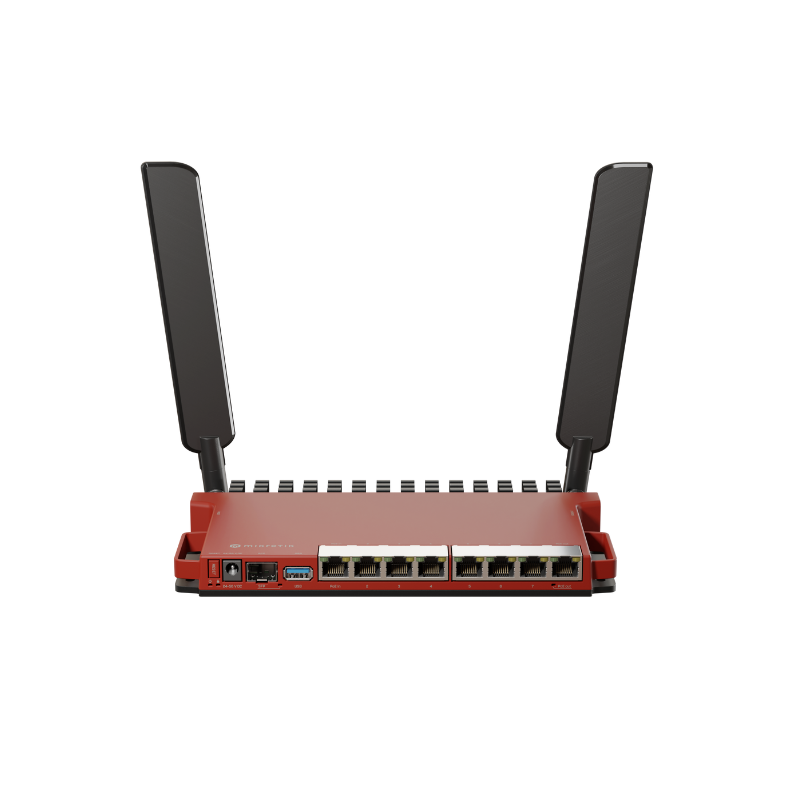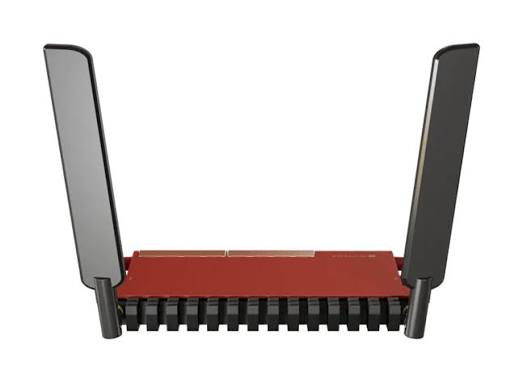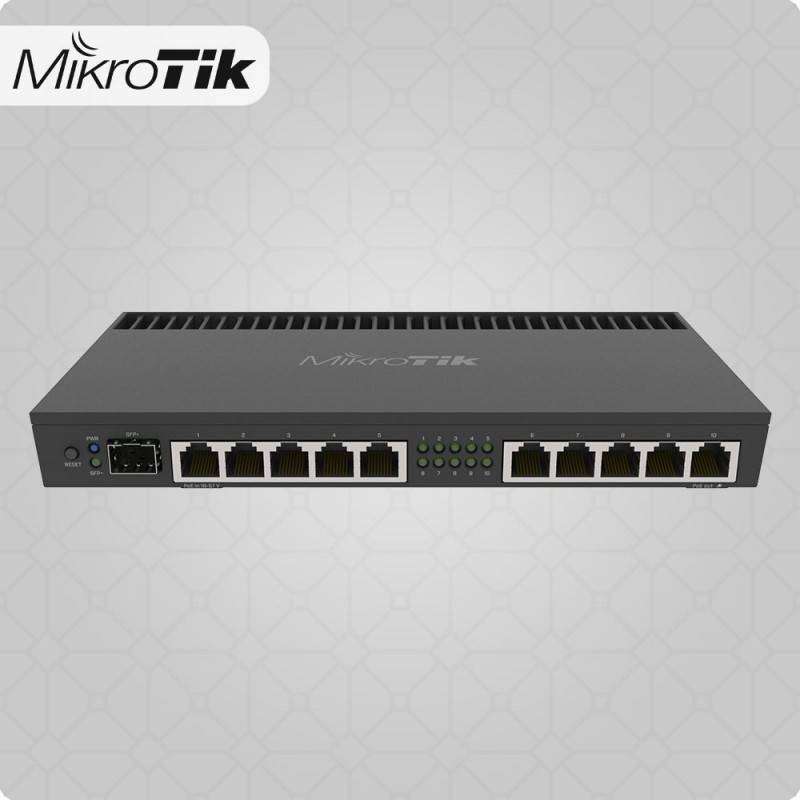
MikroTik RB4011iGS+RM
Buy MikroTik RB4011iGS+RM in Kenya from Orbitlink Solutions. 10 Gigabit Ethernet ports, 10G SFP+, quad-core ARM CPU, 1GB RAM, PoE and RouterOS v7.
MikroTik RB4011iGS+RM Router in Kenya
The MikroTik RB4011iGS+RM is a powerful professional wired router designed for businesses, ISPs, branch networks, CCTV systems, fibre installations, Starlink deployments and advanced RouterOS environments. It combines 10 Gigabit Ethernet ports, one 10Gbps SFP+ cage, a quad-core Cortex-A15 processor, 1GB RAM, passive PoE input/output and RouterOS v7 in a compact fanless metal enclosure.
The RB4011 sits above entry and mid-range MikroTik routers such as the hEX and L009 in processing capability while remaining below newer high-performance platforms such as the RB5009 and Cloud Core Router series. Its combination of multiple Gigabit interfaces and a 10G SFP+ uplink makes it particularly useful where several Gigabit networks need to connect to a faster fibre or aggregation backbone.
MikroTik continues to list the RB4011iGS+RM as a current product, with RouterOS v7 support and an official manufacturer suggested price of US$219. That figure is MikroTik's reference price rather than an Orbitlink Solutions Kenya quotation.
MikroTik RB4011iGS+RM Key Features
| Feature | Specification |
|---|---|
| Product Code | RB4011iGS+RM |
| Architecture | ARM 32-bit |
| CPU | AL21400 |
| CPU Family | Cortex-A15 |
| CPU Cores | 4 |
| CPU Threads | 4 |
| CPU Frequency | Auto, 533–1900MHz |
| Common Product Description | Quad-core 1.4GHz class |
| RAM | 1GB |
| Storage | 512MB NAND |
| Gigabit Ethernet | 10 × 10/100/1000 |
| SFP+ | 1 × 10Gbps |
| PoE-In | Ether1, passive PoE |
| PoE-Out | Ether10, passive PoE |
| Switch Chip | RTL8367SB |
| Serial Console | RJ45 |
| RouterOS | RouterOS v7 |
| RouterOS Licence | Level 5 |
| Cooling | Passive / fanless |
| Dimensions | 228 × 120 × 30mm |
| Rackmount | Rack ears included |
| Tested Temperature | -40°C to +70°C |
| Best For | SMB, ISP edge, fibre, Starlink, VLAN, VPN, multi-WAN |
MikroTik's current specification lists the AL21400 as an ARM 32-bit processor with four cores, automatic frequency scaling from 533MHz to 1900MHz, 1GB RAM and 512MB NAND storage.
10 Gigabit Ethernet Ports
The RB4011iGS+RM provides ten 10/100/1000Mbps Ethernet ports, allowing it to connect a substantial number of wired devices or network segments without immediately requiring a separate access switch.
Possible assignments include:
| Port | Example Use |
|---|---|
| Ether1 | Fibre ISP / primary WAN / PoE-In |
| Ether2 | Starlink |
| Ether3 | Secondary ISP |
| Ether4 | Office LAN |
| Ether5 | CCTV |
| Ether6 | Servers |
| Ether7 | Guest network |
| Ether8 | VoIP |
| Ether9 | Access point / switch |
| Ether10 | PoE-powered compatible device |
RouterOS does not require the ports to remain in one fixed WAN/LAN arrangement. They can be configured for routing, VLANs, bridges, multiple WANs and other network roles.
Ethernet Ports Are Arranged in Two Groups
An important architectural detail is that the ten Ethernet interfaces are organized as two groups of five ports, with each group connected through a switch chip. MikroTik's current hardware manual explicitly documents this internal structure.
This matters when evaluating performance.
Ten Gigabit Ethernet interfaces do not mean ten completely independent dedicated CPU links capable of simultaneously delivering 10Gbps of arbitrary firewall, NAT, queue or VPN processing.
Traffic behaviour depends on whether it is:
-
Switched
-
Bridged
-
Routed
-
Filtered
-
NATed
-
Queued
-
Encrypted
-
Sent through the CPU
Good network design should therefore consider the RB4011's internal port groups as well as its raw port count.
One 10G SFP+ Interface
The RB4011 includes one SFP+ cage capable of 10 Gigabit connectivity. The interface accepts compatible SFP and SFP+ modules.
This is one of the RB4011's biggest advantages over lower-tier MikroTik platforms.
The SFP+ port can be used for:
-
10G core-switch uplink
-
10G fibre backbone
-
Server connection
-
ISP fibre
-
Distribution switch
-
Data-centre connection
-
Inter-building fibre
-
High-speed aggregation
A common architecture is:
Internet / WAN
↓
RB4011
↓
10G SFP+
↓
Core / Distribution Switch
↓
Multiple Gigabit Access Networks
SFP+ Modules and Fibre Connectivity
The SFP+ interface allows the RB4011 to connect to compatible fibre or DAC infrastructure.
Depending on the application, the installation may use:
-
1G SFP optical modules
-
10G SFP+ optical modules
-
SFP+ DAC cables
-
Supported copper transceivers
-
Single-mode fibre
-
Multimode fibre
The correct module depends on:
Speed
Fibre type
Distance
Wavelength
Connector type
Link partner
MikroTik compatibility
Compatibility should be confirmed before ordering optics, especially where non-standard intermediate rates are required. MikroTik's hardware manual directs users to the official wired-interface compatibility information for supported modules.
Powerful Quad-Core Cortex-A15 Processor
The RB4011 uses MikroTik's AL21400 quad-core ARM processor, based on Cortex-A15 technology. MikroTik notes that the same CPU family was also used in its carrier-grade RB1100AHx4 platform.
The current specification lists:
4 CPU cores
4 threads
533–1900MHz automatic frequency range
This gives the RB4011 considerably more processing capability than older MikroTik routers such as the RB2011 and entry-level hEX platforms.
Typical workloads include:
-
NAT
-
Firewall
-
VLAN routing
-
VPN
-
Multi-WAN
-
OSPF
-
BGP
-
Queues
-
QoS
-
IPsec
-
Hotspot
-
PPPoE
-
Policy routing
1GB RAM
The RB4011 includes 1GB of RAM, which is substantial for its class and gives RouterOS room for more complex network configurations.
This memory can help in environments involving:
-
Large connection tables
-
Multiple VLANs
-
VPN tunnels
-
Dynamic routing
-
Firewall rules
-
Queues
-
Monitoring
-
Multiple WAN connections
The router also contains 512MB NAND storage.
RouterOS v7
The RB4011iGS+RM currently supports RouterOS v7 and includes a Level 5 RouterOS licence.
RouterOS provides functionality including:
-
Firewall
-
NAT
-
VLANs
-
DHCP
-
IPv6
-
BGP
-
OSPF
-
Static routing
-
IPsec
-
VPN
-
Queues
-
QoS
-
Policy routing
-
Multi-WAN
-
PPPoE
-
Hotspot
-
SNMP
-
Monitoring
-
Scripting
MikroTik's April 2026 quick guide states that supported models, including the RB4011iGS+RM, should run RouterOS v7.12 or the latest applicable version for current regulatory compliance. MikroTik's product page currently lists RouterOS v7.24.2 as the stable ARM download.
RouterOS Level 5 Licence
The RB4011 uses a RouterOS Level 5 licence, which is already installed on the device and does not require a separate RouterOS purchase.
For the majority of business, enterprise-branch, hotspot and ISP-edge deployments, this licence provides the RouterOS capabilities expected from the RB4011 platform.
IPsec Hardware Acceleration

The RB4011 includes hardware-accelerated IPsec, making it significantly more suitable for encrypted site-to-site networking than many older lower-end MikroTik routers.
Possible applications include:
Head Office ↔ Branch Office
Business ↔ Data Centre
Office ↔ Cloud
Remote Site ↔ Headquarters
Secure ISP / network-management tunnels
MikroTik publishes IPsec performance tests for the model.
RB4011 IPsec Performance
In MikroTik's official lab benchmark using AES-128-CBC + SHA1, a single tunnel with 1400-byte packets reached approximately 1.03Gbps. In the manufacturer's 256-tunnel test, results reached approximately 1.29Gbps for several tested AES combinations at the same packet size.
These figures are controlled laboratory results rather than guaranteed real-world VPN speeds.
Actual encrypted performance depends on:
-
Encryption algorithm
-
VPN protocol
-
Packet size
-
Number of tunnels
-
Firewall rules
-
NAT
-
Queues
-
RouterOS version
-
Other simultaneous traffic
A customer should therefore not interpret “10G SFP+” as meaning 10Gbps encrypted VPN performance.
RB4011 Routing Performance
MikroTik publishes detailed RFC2544 routing benchmarks for the RB4011.
For large 1518-byte packets, MikroTik reports approximately:
| Configuration | Manufacturer Lab Result |
|---|---|
| Fast-path routing | ~9.79Gbps |
| 25 simple queues | ~9.79Gbps |
| 25 IP filter rules | ~7.21Gbps |
Performance changes considerably with smaller packets. For example, the same test with 64-byte packets and 25 IP filter rules produces only about 289Mbps because packet-processing load rises dramatically.
This is an important example of why router performance should never be reduced to a single Mbps or Gbps number.
Understanding MikroTik Performance Figures
MikroTik's published results are performed with specialized Xena Networks testing equipment using RFC2544 methodology. The manufacturer explicitly states that the figures represent maximum performance under the specified test conditions and that different configurations will most likely produce lower results.
Real-world throughput depends on:
-
Packet size
-
NAT
-
Firewall complexity
-
FastTrack
-
Queues
-
VPN
-
Number of connections
-
VLAN configuration
-
Routing protocols
-
Logging
-
RouterOS settings
The RB4011 can be extremely fast when correctly configured, but the physical interface speeds should not be treated as universal guaranteed routed throughput.
Passive PoE-In on Ether1
The RB4011 can receive power through Ether1 using passive PoE.
MikroTik currently specifies:
PoE-In voltage: 18–57V DC
The router can alternatively be powered through its DC jack, which accepts 12–57V DC.
This gives installers flexibility in network cabinets and remote deployments.
Important PoE Note
The RB4011's input is passive PoE, not a universal statement of 802.3af/at support.
The power source and voltage must therefore be checked for compatibility before connecting it.
Passive PoE-Out on Ether10
The RB4011 can also provide passive PoE output through Ether10.
MikroTik specifies:
| PoE-Out Specification | Value |
|---|---|
| PoE-Out Port | Ether10 |
| Type | Passive PoE |
| Maximum Voltage | Up to 57V |
| Low-Voltage Current Limit | 600mA |
| High-Voltage Current Limit | 420mA |
| Maximum Total Output | 600mA |
This may be useful for powering a compatible:
-
MikroTik wireless radio
-
Access point
-
CPE
-
Other passive-PoE device
Voltage and PoE compatibility must be verified first. Passive PoE equipment should never be connected based only on the fact that both products use the term “PoE.”
Power Consumption
Official current specifications list:
| Power Specification | Value |
|---|---|
| DC Inputs | 2 |
| DC Jack | 12–57V |
| PoE-In | 18–57V passive |
| Consumption Without Attachments | 18W |
| Maximum Consumption | 33W |
| Included Adapter | 24V 1.5A |
The higher maximum figure allows for attached loads such as PoE-powered equipment.
Fanless Passive Cooling
The RB4011iGS+RM is passively cooled, meaning it does not rely on a cooling fan.
The solid metal enclosure helps dissipate heat while keeping the router quiet.
This makes it useful in:
-
Offices
-
Network cabinets
-
Home labs
-
Server rooms
-
Branch offices
-
Retail environments
Adequate airflow should still be maintained around the unit.
Solid Metal Enclosure
MikroTik uses a compact matte-black metal enclosure for the RB4011.
Its dimensions are approximately:
228 × 120 × 30mm.
The design allows desktop placement while also supporting rack installation using the supplied rack ears.
Rackmount Installation
The RM version includes two rackmount ears designed to secure the router in a standard rack environment.
MikroTik's current hardware manual confirms that the unit can either be installed in a rack using the supplied brackets or placed on a desktop using the appropriate rubber feet.
This makes the RB4011 suitable for:
-
Server racks
-
Network cabinets
-
ISP POPs
-
Office communications racks
-
Structured cabling rooms
Indoor Installation
The RB4011iGS+RM is designed for indoor use.
MikroTik recommends a dry, ventilated environment and states that the device has no protection against water contamination. Its current manual also recommends Cat6 cabling and professional mounting/configuration.
The official tested temperature range is approximately:
-40°C to +70°C.
The wide tested temperature range does not make the unit an outdoor weatherproof router.
MikroTik RB4011 for Fibre Internet
The RB4011 is particularly useful as a high-performance business fibre gateway.
A typical configuration is:
Fibre ONT
↓
RB4011iGS+RM
↓
10G SFP+ Core Switch
↓
Office / Wi-Fi / CCTV / Servers
RouterOS can then manage:
-
PPPoE
-
DHCP WAN
-
Static IP
-
NAT
-
Firewall
-
VLANs
-
VPN
-
Queues
-
Multiple networks
Where the ISP and optical infrastructure permit it, the SFP+ interface may also be incorporated directly into the fibre network design using a compatible module.
MikroTik RB4011 for Starlink
The RB4011 can be used as a sophisticated RouterOS gateway behind a Starlink connection.
A typical network could be:
Starlink
↓
Ethernet
↓
RB4011
↓
Managed Switch
↓
Wi-Fi / CCTV / Servers / Office Devices
The RB4011 can then provide:
-
Advanced firewalling
-
VLANs
-
Guest-network isolation
-
VPN
-
QoS
-
Bandwidth control
-
Multiple LAN networks
-
Monitoring
-
Dedicated access-point integration
The exact physical connection to Starlink depends on the Starlink kit and network architecture.
Fibre + Starlink Failover
A useful application is combining a primary fibre connection with Starlink as backup.
Fibre → WAN 1
Starlink → WAN 2
↓
RB4011
↓
Business LAN
RouterOS can be configured to detect a problem with the primary route and move traffic to the backup connection.
When the primary connection recovers, routing can return to the preferred WAN.
This architecture can benefit:
-
Offices
-
Hotels
-
Schools
-
Hospitals
-
Retail businesses
-
Data-dependent organisations
MikroTik RB4011 for Multi-WAN
The RB4011's 10 Gigabit Ethernet interfaces make it suitable for networks with multiple internet connections.
For example:
Ether1 → Fibre ISP
Ether2 → Starlink
Ether3 → Secondary fibre
Ether4 → 4G/5G router
Remaining ports → Internal networks
RouterOS can implement:
-
Failover
-
Policy routing
-
WAN monitoring
-
Traffic distribution
-
Different WANs for different VLANs
It is important to distinguish load balancing from bonding. Multiple internet connections do not automatically combine into one faster single-session connection.
MikroTik RB4011 for VLAN Networks
The RB4011 can serve as a central Layer 3 gateway for segmented business networks.
| VLAN | Purpose |
|---|---|
| 10 | Network Management |
| 20 | Staff |
| 30 | Guest Wi-Fi |
| 40 | CCTV |
| 50 | VoIP |
| 60 | Servers |
| 70 | IoT |
| 80 | POS / Business Systems |
RouterOS firewall rules can then control communication between those segments.
For example:
Guest → Internet only
CCTV → NVR only
IoT → Restricted network
Staff → Internet + authorized servers
Management → Network equipment
This is far more secure than placing every device on one unrestricted LAN.
MikroTik RB4011 for CCTV Networks
The RB4011 is useful as a gateway and segmentation router for larger CCTV installations.
A common architecture is:
Internet
↓
RB4011
↓
Managed PoE Switch
↓
IP Cameras + NVR
The RB4011 can separate CCTV traffic into a dedicated VLAN and restrict communication using RouterOS firewall policies.
A separate PoE switch should normally provide power to multiple cameras rather than expecting Ether10 to power an entire CCTV system.
MikroTik RB4011 for Wi-Fi Networks
The RB4011iGS+RM has no built-in Wi-Fi.
For professional deployments, it can instead be paired with dedicated access points:
Internet
↓
RB4011
↓
PoE Managed Switch
↓
Multiple Wi-Fi Access Points
This architecture can provide better wireless coverage than relying on one central wireless router, especially in:
-
Offices
-
Hotels
-
Schools
-
Restaurants
-
Apartment buildings
-
Multi-floor premises
The RB4011 manages routing while access points can be positioned according to coverage requirements.
MikroTik RB4011 for Hotspot Networks
RouterOS provides hotspot functionality, making the RB4011 suitable as the routing layer for managed public-access networks.
Possible environments include:
-
Hotels
-
Restaurants
-
Apartments
-
Schools
-
Offices
-
Events
-
Small campuses
A typical structure is:
ISP → RB4011 → PoE Switch → Access Points → Users
The RB4011 can handle routing, DHCP, firewall policies, queues and hotspot services while dedicated APs provide wireless coverage.
MikroTik RB4011 for VPN
The RB4011 is a strong option for small-to-medium business VPN environments because of its ARM processing platform and IPsec hardware acceleration.
Applications include:
Branch ↔ Head Office
Remote User ↔ Office
Office ↔ Cloud
Office ↔ Data Centre
For heavier VPN requirements—particularly multi-gigabit encrypted workloads—a more powerful RB5009 or CCR platform should also be evaluated.
MikroTik RB4011 for OSPF
RouterOS v7 supports OSPF, allowing the RB4011 to participate in dynamically routed networks.
For example:
Head Office RB4011
↕
Branch Router
↕
Warehouse Router
↕
Remote Site
OSPF can automatically exchange routes between the participating routers rather than requiring every internal network route to be manually configured.
MikroTik RB4011 for BGP
The RB4011 can run BGP under RouterOS v7, making it suitable for certain ISP, lab and advanced enterprise routing environments.
However, the ability to run BGP and the suitability for a particular BGP deployment are not the same thing.
For large full-table ISP environments, much more powerful platforms such as:
-
CCR2004
-
CCR2116
-
CCR2216
may be more appropriate because they provide greater CPU, RAM and high-speed interface capacity.
RB4011iGS+RM vs MikroTik L009UiGS-RM
| Feature | RB4011iGS+RM | L009UiGS-RM |
|---|---|---|
| CPU Cores | 4 | 2 |
| CPU Class | Cortex-A15 | IPQ-5018 |
| RAM | 1GB | 512MB |
| Gigabit Ethernet | 10 | 8 |
| SFP Interface | 10G SFP+ | Up to 2.5G |
| PoE-In | Passive | 802.3af/at capable |
| PoE-Out | Ether10 | Ether8 |
| USB | No | USB 3.0 |
| Container Support | Architecture-dependent/less compelling | Highlighted by MikroTik |
| Cooling | Passive | Passive |
| Main Strength | Routing + 10G | Modern low-cost SMB gateway |
The L009 is a modern and efficient option for ordinary Gigabit networks.
The RB4011 remains much more attractive where 10 Gigabit uplink capability and stronger routing performance are required.
RB4011iGS+RM vs RB5009UG+S+IN
The RB5009 is the newer high-performance successor-class alternative for many deployments.
| Feature | RB4011iGS+RM | RB5009UG+S+IN |
|---|---|---|
| CPU Cores | 4 | 4 |
| CPU Platform | Cortex-A15 | Newer ARM64 |
| RAM | 1GB | 1GB |
| Gigabit Ethernet | 10 | 7 |
| 2.5GbE RJ45 | No | Yes |
| 10G SFP+ | Yes | Yes |
| USB 3.0 | No | Yes |
| PoE-In | Passive | Multiple powering options |
| Main Advantage | More 1G ports | Newer architecture / higher flexibility |
The RB4011 remains attractive when the installation benefits from ten built-in Gigabit ports.
The RB5009 is generally more attractive for new performance-focused deployments where a newer CPU platform, 2.5GbE and USB 3.0 are valuable.
RB4011iGS+RM vs CCR2004-16G-2S+
| Feature | RB4011iGS+RM | CCR2004-16G-2S+ |
|---|---|---|
| CPU Cores | 4 | 4 |
| Architecture | ARM | ARM64 |
| RAM | 1GB | 4GB |
| Gigabit Ethernet | 10 | 16 |
| 10G SFP+ | 1 | 2 |
| RouterOS Licence | L5 | L6 |
| Cooling | Passive | Active |
| Main Market | SMB / advanced office / ISP edge | ISP / enterprise |
The CCR2004 is significantly more suitable for larger routing deployments that require more RAM, more Ethernet connectivity and dual 10G interfaces.
The RB4011 remains more compact and is suitable for networks that do not require CCR-level capacity.
RB4011iGS+RM vs CCR2116-12G-4S+
There is a substantial performance-class difference between these devices.
The RB4011 is designed for advanced SMB and moderate ISP routing.
The CCR2116 provides:
-
16 CPU cores
-
16GB RAM
-
Four 10G SFP+
-
Layer 3 hardware offloading
-
Much greater routing capacity
The CCR2116 is therefore more appropriate for major BGP, ISP backbone and high-throughput enterprise applications.
RB4011 vs RB3011
The RB4011 represents a significant performance upgrade from the older RB3011 generation.
Its advantages include:
-
More powerful quad-core processor
-
ARM architecture
-
1GB RAM
-
10 Gigabit Ethernet ports
-
10G SFP+
-
IPsec hardware acceleration
-
Passive cooling
For networks still operating older RB3011 equipment, the RB4011 can remain a useful upgrade option, although the newer RB5009 should also be considered for fresh installations.
Main Advantages of MikroTik RB4011iGS+RM
The RB4011 provides an attractive combination of ten Gigabit Ethernet ports, one 10G SFP+ interface, quad-core ARM processing, 1GB RAM, IPsec hardware acceleration, passive cooling and RouterOS v7.
Its major strengths include:
-
10 Gigabit Ethernet ports
-
10G SFP+
-
Strong routing performance
-
Quad-core CPU
-
1GB RAM
-
Hardware-accelerated IPsec
-
PoE input
-
PoE output
-
VLAN support
-
Multi-WAN
-
VPN
-
OSPF
-
BGP
-
Rackmount capability
-
Fanless design
-
Mature RouterOS platform
Limitations of MikroTik RB4011iGS+RM
The RB4011 is powerful, but several limitations should be understood.
It has only one 10G SFP+ interface, so networks requiring multiple 10G links may be better served by the CCR2004 or higher platforms. It also lacks modern 2.5GbE copper ports and does not provide USB connectivity.
Its Ethernet ports are divided into two switch-chip groups rather than each having an independent dedicated CPU path.
The RB4011 also uses passive PoE rather than a universal PoE implementation, meaning power-source and downstream-device compatibility must be checked carefully.
Finally, although it remains current, newer hardware such as the RB5009 may be more appropriate for some fresh installations.
Who Should Buy the MikroTik RB4011iGS+RM?
The RB4011 is particularly suitable for medium businesses, advanced offices, fibre installations, Starlink deployments, CCTV networks, hotels, schools, branch offices, small ISPs and organisations requiring multiple Gigabit interfaces plus a 10G backbone connection.
It is especially attractive where a network needs more built-in Ethernet ports than an RB5009 but does not yet require the processing and interface capacity of a Cloud Core Router.
For a basic home or small office using only a few devices, it may be unnecessary. For large ISP cores, full-table BGP or multi-10G networks, a CCR platform is usually more appropriate.
Typical RB4011 Business Network
A practical deployment could look like:
Primary Fibre ISP
↓
RB4011iGS+RM
↑
Starlink Backup
↓
10G SFP+ Core Switch
↓
PoE Switches
↓
Wi-Fi Access Points / CCTV / Servers / VoIP / Office Users
The RB4011 can handle the routing, firewalling, VLANs, VPN and multi-WAN logic while downstream switches provide access-layer connectivity.
What's Included in the Box?
MikroTik's current product page and hardware manual list the following main accessories:
| Included Item | Status |
|---|---|
| RB4011iGS+RM Router | Included |
| 24V 1.5A Power Adapter | Included |
| Rackmount Ears | Included |
| K-60 Fastening Set | Included |
The SFP/SFP+ module is not included and should be selected separately according to the required fibre type, distance and speed.
MikroTik RB4011iGS+RM Price in Kenya
MikroTik currently lists a manufacturer suggested price of US$219 for the RB4011iGS+RM. This is the manufacturer's international reference price and not an Orbitlink Solutions Kenya retail price.
Actual Kenya pricing may vary depending on:
-
Exchange rates
-
Freight
-
Taxes
-
Distributor pricing
-
Current stock
-
Included accessories
Contact Orbitlink Solutions for the current MikroTik RB4011iGS+RM price and stock availability in Kenya.
A complete installation may additionally require an SFP+ module or DAC, fibre patch cords, managed switches, Wi-Fi access points, UPS equipment and professional RouterOS configuration.
Why Buy MikroTik RB4011iGS+RM from Orbitlink Solutions?
Choosing between the RB4011, L009, RB5009 and CCR platforms should depend on the actual network rather than only the product specification.
The RB4011 is particularly compelling when ten Gigabit copper interfaces and one 10G uplink are useful. A smaller Gigabit deployment may be better served by an L009, while a new network requiring 2.5GbE or newer processing may favour the RB5009. A larger ISP or enterprise environment may instead require a CCR2004, CCR2116 or CCR2216.
Orbitlink Solutions can also help match the router with suitable SFP+ modules, fibre infrastructure, managed switches, access points, cabling and RouterOS configuration.
Watch the MikroTik RB4011iGS+RM Video
The RB4011iGS+RM remains an interesting MikroTik router because it combines unusually high copper-port density with a true 10Gbps SFP+ uplink. Ten Gigabit Ethernet interfaces can accommodate several WAN and LAN networks directly, while the SFP+ interface allows the router to connect to a faster distribution or fibre backbone. MikroTik's official benchmarks demonstrate that the platform can approach 10Gbps in favourable fast-path, large-packet laboratory conditions, although real-world performance varies substantially once filtering, queues, VPNs and smaller packets are introduced.
Its quad-core Cortex-A15-class CPU and 1GB RAM also position it well above basic RouterBOARD gateways. Hardware-assisted IPsec is particularly useful for businesses connecting branches or data centres over secure tunnels, while RouterOS v7 provides VLAN, OSPF, BGP, firewall, multi-WAN and policy-routing functionality on the same platform.
For a new deployment, the RB4011 should nevertheless be compared carefully with the RB5009. The RB5009 offers a newer architecture and modern connectivity options, while the RB4011's major advantage remains its ten built-in Gigabit Ethernet interfaces. Where that port count is valuable and one 10G uplink is sufficient, the RB4011 can still be a very practical professional router.
Frequently Asked Questions About MikroTik RB4011iGS+RM
What is the MikroTik RB4011iGS+RM?
It is a professional RouterOS v7 Ethernet router with 10 Gigabit Ethernet ports, one 10G SFP+ interface, a quad-core ARM processor, 1GB RAM and IPsec hardware acceleration.
How many Ethernet ports does RB4011 have?
It has 10 × 10/100/1000Mbps Ethernet ports.
Does RB4011 support 10 Gigabit?
Yes. It includes one SFP+ interface capable of 10Gbps connectivity with a compatible module or DAC.
Does the RB4011 include an SFP+ module?
No. MikroTik's product brochure specifies that the 10G SFP+ module is not included.
What CPU does RB4011 use?
It uses the AL21400 quad-core ARM processor, based on Cortex-A15 technology.
What is the RB4011 CPU speed?
MikroTik currently lists automatic CPU frequency scaling from 533MHz to 1900MHz. The product continues to be marketed as a quad-core 1.4GHz-class router.
How much RAM does RB4011 have?
It has 1GB RAM.
How much storage does it have?
It provides 512MB NAND storage.
Does RB4011 run RouterOS v7?
Yes. Current MikroTik documentation lists RouterOS v7.
What RouterOS licence does RB4011 have?
It includes a Level 5 RouterOS licence.
Does RB4011 support VLANs?
Yes. RouterOS provides VLAN creation, tagging, routing and firewall functionality.
Does RB4011 support BGP?
Yes. RouterOS v7 supports BGP, although large carrier-scale BGP deployments may justify a more powerful CCR platform.
Does RB4011 support OSPF?
Yes. RouterOS v7 supports OSPF.
Does RB4011 support VPN?
Yes. It supports RouterOS VPN functionality and includes IPsec hardware acceleration.
How fast is IPsec on the RB4011?
In MikroTik's controlled test, a single AES-128-CBC + SHA1 tunnel with 1400-byte packets reached about 1.03Gbps, while certain 256-tunnel tests were around 1.29Gbps. Real-world performance varies.
Does the RB4011 have Wi-Fi?
No. The RB4011iGS+RM is a wired Ethernet model. Dedicated access points should be used for wireless coverage.
Does RB4011 have PoE input?
Yes. Ether1 supports 18–57V passive PoE input.
Does RB4011 have PoE output?
Yes. Ether10 provides passive PoE output up to 57V, subject to the documented power limits.
Is RB4011 PoE-Out 802.3af/at?
MikroTik specifies the output as passive PoE, so it should not automatically be treated as standard 802.3af/at. Verify the powered device's voltage and PoE requirements.
Is the RB4011 fanless?
Yes. It uses passive cooling.
Can RB4011 work with Starlink?
Yes. It can be used as an advanced RouterOS gateway behind a Starlink Ethernet connection.
Can RB4011 combine Starlink and fibre?
Yes. RouterOS can implement failover, multi-WAN and policy routing between Starlink and fibre connections.
Can RB4011 load balance two internet connections?
Yes, RouterOS can distribute connections across multiple WANs. However, load balancing does not automatically bond two connections into one faster single session.
Is RB4011 suitable for CCTV?
Yes. It can provide VLANs, routing and firewall isolation for CCTV infrastructure. Multiple cameras would normally be powered through a separate PoE switch.
Can RB4011 be used with Wi-Fi access points?
Yes. A common business architecture uses the RB4011 as the router and dedicated wired access points for wireless coverage.
Is RB4011 rackmountable?
Yes. The RB4011iGS+RM includes rackmount ears and can be installed in a standard rack enclosure.
Is RB4011 waterproof?
No. MikroTik specifies it for indoor installation in a dry and ventilated environment.
Is RB4011 better than L009?
The RB4011 provides significantly greater CPU performance, ten Gigabit ports and a true 10G SFP+ interface. The L009 is newer and more economical for ordinary Gigabit deployments.
Is RB4011 better than RB5009?
Not universally. The RB5009 has a newer architecture, 2.5GbE and 10G SFP+, while the RB4011 provides more built-in Gigabit Ethernet ports. The better option depends on the network.
Is RB4011 suitable for an ISP?
Yes, particularly for smaller ISP, edge-routing, POP and aggregation applications. Larger BGP or multi-10G environments should also evaluate CCR models.
What is the MikroTik RB4011iGS+RM price in Kenya?
Contact Orbitlink Solutions for the current exact-model price and stock availability.
Buy MikroTik RB4011iGS+RM in Kenya
The MikroTik RB4011iGS+RM remains a strong professional RouterOS platform for networks requiring 10 Gigabit Ethernet ports, a 10G SFP+ uplink, quad-core processing, 1GB RAM, IPsec hardware acceleration and advanced routing capabilities.
It is particularly suitable for business fibre connections, Starlink integration, multi-WAN gateways, CCTV segmentation, VPN, VLAN networks and smaller ISP deployments. For newer high-performance requirements, the RB5009 and CCR families should also be considered before final selection.
Contact Orbitlink Solutions
Orbitlink Solutions
Lyric House, 7th Floor, Room S9, Kimathi Street, Nairobi
Call / Text / WhatsApp: +254 743 720 551
Email: info@orbitlinksolutions.co.ke
Alternative Email: orbitlinksolutions@gmail.com
Opening Hours: Monday–Saturday, 9:00 AM–6:00 PM
Availability: Nairobi pickup and nationwide delivery
Contact Orbitlink Solutions for the current MikroTik RB4011iGS+RM price in Kenya, stock availability, SFP+ selection, RouterOS configuration and deployment guidance for fibre, Starlink, VLAN, VPN, CCTV and multi-WAN networks.
Need Help Choosing? Ask a Technician
Get guidance on setup, compatibility, stock, and delivery before buying for your project.